Can Cursor run a beginner YouTube channel? A 7-day real-world experiment
Post:
I am starting a seven-day experiment: can one Cursor project become the main workstation for a beginner YouTube creator?
I am not testing only script generation. I want to test the complete workflow: content planning, research, a personal RAG, connecting useful services, video creation, upload preparation, comment management, and agent-driven automation.
This is not a new RAG product or a one-click content generator. I am testing Cursor itself as the workspace.
I will use a real channel and post the results here: what worked, what failed, which steps can be automated safely, and where a separate tool or human decision is still needed.
The 7-day plan
Day 1 — Channel and content plan
Define the channel topic, target viewer, video format, and first 10 video ideas. Turn them into a simple first-month content calendar.
Day 2 — Research system
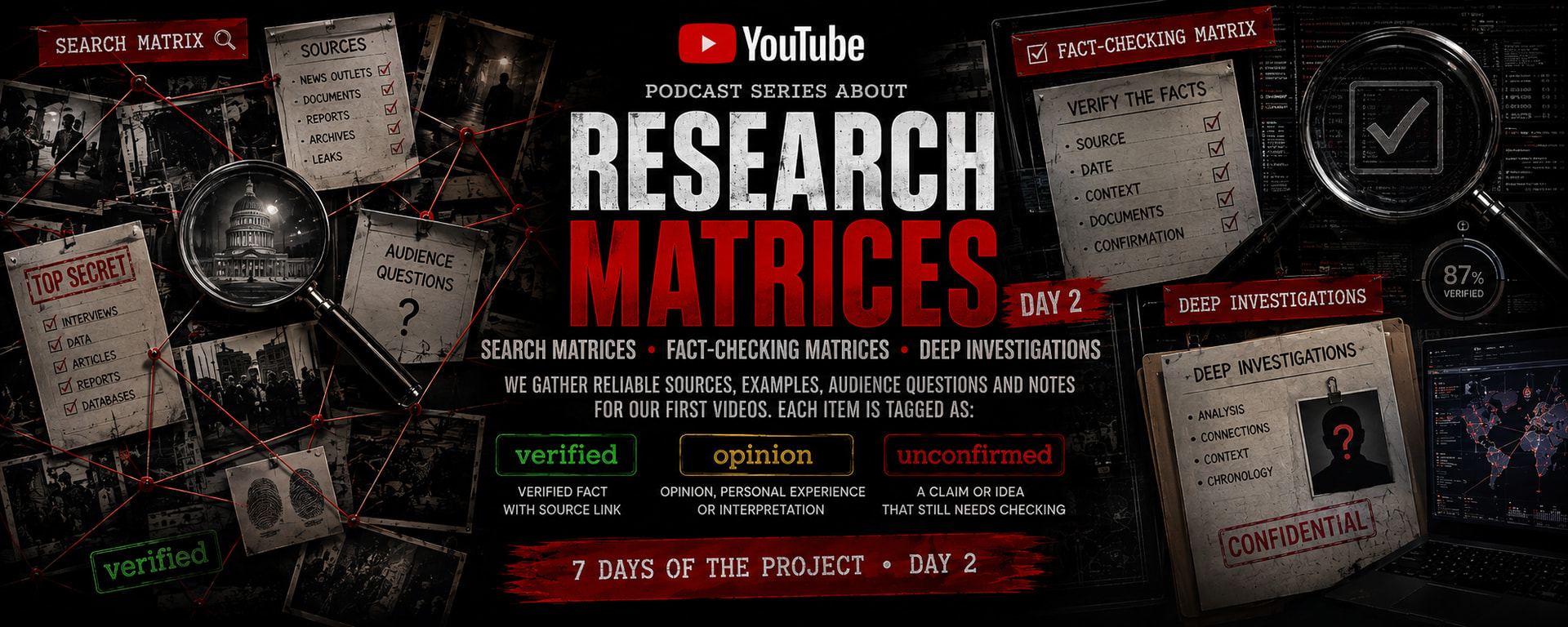
Collect reliable sources, examples, audience questions, and notes for the first videos. Mark every item as verified, opinion, or still unconfirmed.
Day 3 — Channel RAG and memory
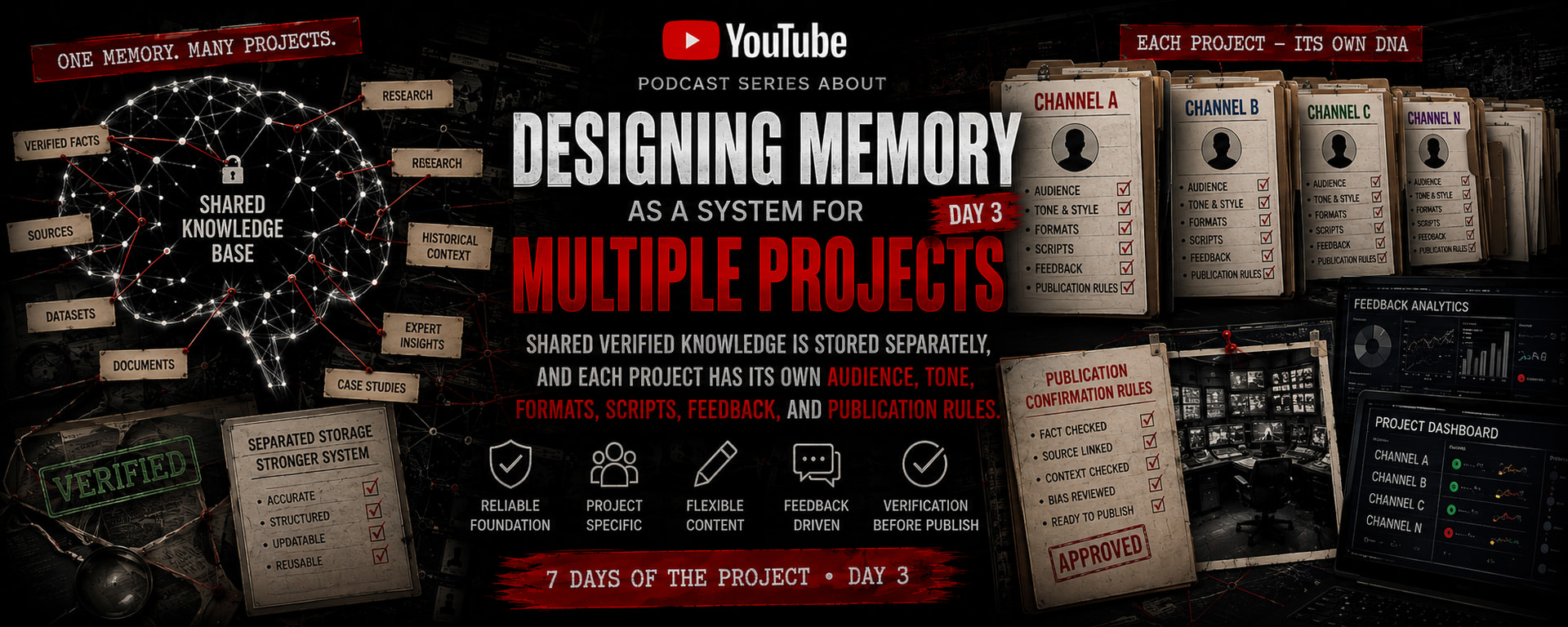
Build a local knowledge base for sources, content ideas, writing rules, past scripts, useful examples, and corrections. The goal is to keep working context between videos instead of starting from an empty prompt.
Day 4 — Connect useful services
Connect only services that solve a real step through APIs, MCP, or browser workflows: research, transcription, image generation, storage, and upload preparation. Keep credentials outside prompts and project files.
Day 5 — Create a real video package
Take one idea from the content plan, research it through the RAG, and create hooks, an outline, a 60–90 second script, title options, a description, a thumbnail brief, and a recording checklist.
Day 6 — Prepare and upload
Prepare assets and metadata for publication. Test a safe upload workflow with a final manual approval step before anything becomes public.
Day 7 — Work with comments and review the workflow
Collect new comments and separate them into questions, feedback, spam, and useful corrections. Let agents prepare draft replies and a short report, then review everything manually. Finish by documenting what Cursor handled well, what needs another tool, and what should stay human.
Rules
No factual claim without a saved source.
If information is missing, Cursor asks instead of inventing an answer.
Scripts stay short, direct, and human.
No agent publishes content, sends messages, or uses an external account without approval.
Every automated step needs a visible result and a manual check.
By the end of the week, I want a practical answer: how much of a real beginner YouTube workflow can be planned, researched, structured, generated, checked, and managed from one Cursor project.
I will update this thread in real time. Questions, criticism, and alternative workflows are welcome.
This is really cool! Please keep us updated. You might want to double-check YouTube’s policies for AI-generated content and just make sure you’re following the correct rules, etc. Let us know how it goes!
Today, we’ll start with simple and clear tasks: define the channel’s niche and analyze the accumulated experience of the most successful YouTubers, psychologists, manipulators, and propagandists.
The goal is for our videos to be more than just a demonstration of what agents managed through Cursor can do. They should also bring traffic and subscribers.
When choosing a niche, we need to think in terms of unlimited content capacity. The first thing that comes to mind is biographies. They have high-volume keywords and naturally attract audience attention: Elon Musk, Trump, Epstein, and so on.
You may ask: why biographies? Why not something else? I’ll answer that later.
If I had seen a task like this a few years ago, I would have said with confidence that it would take at least three months and require a budget of $15,000–$30,000.
But in today’s reality, with a $60 Cursor subscription, we can solve this task in five minutes. Writing this post will take longer, but it is necessary: the process of writing helps turn the original seven-day plan into a detailed roadmap.
Enough writing already, right? Time to do something. Let’s open Cursor, ask it to create a research prompt, and then send that prompt to an orchestrated swarm of agents for execution.
I put everything into one prompt to understand both how to make the content and whom to make it about.
The prompt turned out to be substantial and detailed. If anyone is interested, I can send the full version in a private message so I do not clutter the thread.
Prompt:
You are the lead of a research swarm. Conduct independent, evidence-based research from scratch.
Goal
Create an editorial and psychological model for an engaging 10-minute YouTube video for a documentary-investigative series:
“Unknown Shocking Stories”
Topics: disappearances, archival cases, inconsistencies in investigations, forgotten documents, last confirmed sightings, and ordinary places with disturbing histories.
The goal is not to promise “virality” or provide manipulative hacks. Determine which elements of storytelling, editing, evidence, calls to action, and internal linking can reasonably support viewer attention, trust, and movement to the next video.
Work as if no benchmark document exists. Do not fit the findings to a presumed answer.
Research principles
After 20 minutes of work, I received a detailed guide on how to create podcasts properly. According to the AI, even MrBeast would be impressed.
I also got 30 ready-to-produce podcasts about famous people who changed the world, each designed for 10 minutes.
To my surprise, my initially simple and clear plan was adjusted by a subagent, which suggested immediately cutting the podcasts into Shorts.
It sounds great. I do not yet fully understand how this will be implemented, since our goal is automated blogging.
And I almost forgot: why biographies? Here is the answer. This experiment has a limited budget and a limited set of tools:
Cursor with a $60 subscription.
ZennoPoster — yes, we will need it a little later.
Within this experiment, we cannot afford expensive video generation. So we will make videos from images.
A note on how I will run this experiment: I am writing it in public and I will not rewrite earlier posts after publishing them.
Each update is a real working step, not a finished case study. Sometimes an early idea will be too broad, a tool will fail, or a better direction will appear after testing.
When that happens, I will add a short follow-up note explaining what changed and why. This should make the process more useful than presenting a polished result after the fact.
The constant part is simple: sources are checked, public actions stay under human approval, and I will show both useful results and limitations.
Using subagents orchestrated by Cursor, we will build two matrices:
A psychological matrix for audience retention and podcast structure. I created this one yesterday.
A fact-checking and deep-research matrix.
Let’s focus more closely on the second one.
We will work with popular search queries and trends. That creates a risk of finding questionable information, interpreting it incorrectly, and publishing material that could cause problems.
We do not need that. So a separate group of subagents will verify everything found by the others: locate primary sources, compare versions, identify conflicts between sources, and flag claims that cannot be confirmed.
Quick dossier setup
Example: biography of a public figure

Create a dossier_name_date folder using the templates/folder_structure.md template.
In 00_dossier_profile.md, record the subject, name variations, research cutoff date, languages, sensitive topics, and research boundaries.
Assign five researchers to non-overlapping areas from raw_research_matrix.md.
Give each researcher templates/researcher_brief.md and the source-card template.
After the first research pass, the coordinator assigns IDs and links duplicates, but does not fill in or “complete” facts.
Two fact-checkers receive templates/fact_checker_brief.md.
The red team reviews risks only: allegations, quotes, health, private life, causation claims, and current statuses.
The editor receives only the separate 10_editor_handoff.md, not the raw notes.
Minimum discipline
One fact, one card.
One URL does not equal independent confirmation.
An opinion does not become a fact, even if it is popular.
An unverified lead is useful only as a fact-checking task.
No source means no claim in the script.
What to give the editor
10–20 strong verified cards on the selected topic.
1–3 honestly described contradictions.
A “what we do not know” section.
3–5 safe questions for the audience.
Links to documents and the research cutoff date.
Important limitation
A large database is not a finished biography or a finished podcast. Its purpose is to let the next researcher create scripts without repeating the same research or turning rumors into a story.
I won’t publish the full matrices here. If you want, you can build them yourself.
Yes, you can write a piece based on a single source. But it is much more reliable to find a second independent source, compare the information, and openly point out any discrepancies.
That seems clear now. I hope I haven’t tired you out with all the writing.
Let’s move on to the next step: choosing content topics. At first, I planned to create 30 topics, but quickly realized there is no real limit. So let’s start with 100.
The approach is simple: ask the agents to find the top 100 people who changed the world. At the same time, use an MCP tool to check name search volume and trends. That way, these people will not only be important because of their impact on the world, but also relevant in search demand.
After 10 minutes of intensive work by the subagents, we get a list like this.
## Living

Malala Yousafzai — 12 July 1997
Taylor Swift — 13 December 1989
Rihanna — 20 February 1988
Lionel Messi — 24 June 1987
Usain Bolt — 21 August 1986
Eliud Kipchoge — 5 November 1984
Li Na — 26 February 1982
Serena Williams — 26 September 1981
Miroslav Klose — 9 June 1978
Volodymyr Zelenskyy — 25 January 1978
Chimamanda Ngozi Adichie — 15 September 1977
Elon Musk — 28 June 1971
Celine Dion — 30 March 1968
Satya Nadella — 19 August 1967
Jack Ma — 10 September 1964
Michael Jordan — 17 February 1963
Nadia Comăneci — 12 November 1961
Ai Weiwei — 28 August 1957
Angela Merkel — 17 July 1954
Oprah Winfrey — 29 January 1954
Vladimir Putin — 7 October 1952
Donald Trump — 14 June 1946
Aung San Suu Kyi — 19 June 1945
Hayao Miyazaki — 5 January 1941
Ellen Johnson Sirleaf — 29 October 1938
David Attenborough — 8 May 1926

## Deceased

Leila Alaoui — 10 July 1982 – 18 January 2016
Tupac Shakur — 16 June 1971 – 13 September 1996
Diego Maradona — 30 October 1960 – 25 November 2020
Ayrton Senna — 21 March 1960 – 1 May 1994
Benazir Bhutto — 21 June 1953 – 27 December 2007
Zaha Hadid — 31 October 1950 – 31 March 2016
Thomas Sankara — 21 December 1949 – 15 October 1987
Nusrat Fateh Ali Khan — 13 October 1948 – 16 August 1997
Bob Marley — 6 February 1945 – 11 May 1981
Mario Molina — 19 March 1943 – 7 October 2020
Muhammad Ali — 17 January 1942 – 3 June 2016
Bruce Lee — 27 November 1940 – 20 July 1973
Pelé — 23 October 1940 – 29 December 2022
Wangari Maathai — 1 April 1940 – 25 September 2011
Fela Kuti — 15 October 1938 – 2 August 1997
Ngũgĩ wa Thiong’o — 5 January 1938 – 28 May 2025
Alexei Leonov — 30 May 1934 – 11 October 2019
Jane Goodall — 3 April 1934 – 1 October 2025
Yuri Gagarin — 9 March 1934 – 27 March 1968
Nina Simone — 21 February 1933 – 21 April 2003
Toni Morrison — 18 February 1931 – 5 August 2019
Lata Mangeshkar — 28 September 1929 – 6 February 2022
Martin Luther King Jr. — 15 January 1929 – 4 April 1968
Maya Angelou — 4 April 1928 – 28 May 2014
Abdul Sattar Edhi — 28 February 1928 – 8 July 2016
Gabriel García Márquez — 6 March 1927 – 17 April 2014
Malcolm X — 19 May 1925 – 21 February 1965
Shirley Chisholm — 30 November 1924 – 1 January 2005
Lee Kuan Yew — 16 September 1923 – 23 March 2015
Eva Perón — 7 May 1919 – 26 July 1952
Katherine Johnson — 26 August 1918 – 24 February 2020
Nelson Mandela — 18 July 1918 – 5 December 2013
Park Chung-hee — 14 November 1917 – 26 October 1979
Hedy Lamarr — 9 November 1914 – 19 January 2000
Octavio Paz — 31 March 1914 – 19 April 1998
Rosa Parks — 4 February 1913 – 24 October 2005
Alan Turing — 23 June 1912 – 7 June 1954
Akira Kurosawa — 23 March 1910 – 6 September 1998
Astrid Lindgren — 14 November 1907 – 28 January 2002
Frida Kahlo — 6 July 1907 – 13 July 1954
Rachel Carson — 27 May 1907 – 14 April 1964
Grace Hopper — 9 December 1906 – 1 January 1992
Salvador Dalí — 11 May 1904 – 23 January 1989
Antoine de Saint-Exupéry — 29 June 1900 – 31 July 1944
Umm Kulthum — 31 December 1898 – 3 February 1975
Amelia Earhart — 24 July 1897 – 5 January 1939
Ho Chi Minh — 19 May 1890 – 2 September 1969
Coco Chanel — 19 August 1883 – 10 January 1971
Virginia Woolf — 25 January 1882 – 28 March 1941
Helen Keller — 27 June 1880 – 1 June 1968
Albert Einstein — 14 March 1879 – 18 April 1955
Ernest Shackleton — 15 February 1874 – 5 January 1922
Mahatma Gandhi — 2 October 1869 – 30 January 1948
Marie Curie — 7 November 1867 – 4 July 1934
Sun Yat-sen — 12 November 1866 – 12 March 1925
George Washington Carver — 1 January 1864 – 5 January 1943
Rabindranath Tagore — 7 May 1861 – 7 August 1941
Nikola Tesla — 10 July 1856 – 7 January 1943
Vincent van Gogh — 30 March 1853 – 29 July 1890
Thomas Edison — 11 February 1847 – 18 October 1931
Florence Nightingale — 12 May 1820 – 13 August 1910
Ada Lovelace — 10 December 1815 – 27 November 1852
Simón Bolívar — 24 July 1783 – 17 December 1830
René Descartes — 31 March 1596 – 11 February 1650
William Shakespeare — April 1564 – 23 April 1616
Hatshepsut — c. 1507 BCE – 16 January 1458 BCE
Ferdinand Magellan — 20 September 1480 – 27 April 1521
Nicolaus Copernicus — 19 February 1473 – 24 May 1543
Leonardo da Vinci — 15 April 1452 – 2 May 1519
Zheng He — c. 1371 – c. 1433
Rumi — 30 September 1207 – 17 December 1273
Genghis Khan — 31 May 1162 – 25 August 1227
Ibn Sina (Avicenna) — 22 August 980 – 21 June 1037
Al-Khwarizmi — c. 750 – c. 846
Cleopatra VII — 13 January 69 BCE – 12 August 30 BCE
Additionally, we will ask Cursor to write prompts for Suno. Here is what we got:
[10 minutes long] [extended version]
Atmospheric cinematic introduction, mysterious tension building, orchestral elements with electronic undertones, deep bass pulses, suspenseful strings, digital glitches mixed with classical instruments, sense of awakening and discovery, modern documentary style, serious investigative mood, intelligent and sophisticated, evolving soundscape, 120 BPM
Day 2 result: the useful output was not the list of names. It was the research structure.
I separated source collection, fact checking, risk review, and the editor handoff. That means the editor should receive only verified claims, documented contradictions, source links, and a clear “what we do not know” section.
I am also narrowing the first test topics. I will avoid political and conflict-driven subjects. The first RAG test will use neutral topics from technology, science, creative work, and practical automation.
The long list of possible biographies stays in the private research backlog until every item is checked. It is not a publishing plan.
Next step: Day 3 is building the channel memory so sources, corrections, and approved writing rules survive between videos.
A channel memory should not become one large folder where sources, ideas, drafts, accounts, and random notes are mixed together.
I am building this as a small creator operating system inside Cursor. It should support multiple projects and channels without mixing their audience, writing style, research, browser sessions, or publishing workflows.
Shared knowledge is not automatically shared content. A fact can be reused across projects, but every channel still has its own audience, voice, format, approval rules, and risk boundaries.
I also separate durable knowledge from temporary research:
research/ raw notes, leads, hypotheses, incomplete material
Every item has a simple status:
verified — supported by a saved source
opinion — interpretation or personal experience
unconfirmed — useful lead, but not safe for a script
outdated — needs a fresh check before reuse
Each content idea gets its own card:
channel
target audience
main question
source links
verified claims
open questions
risks
approved outline
script status
publishing approval
outcome and lessons
This gives different Cursor agents different responsibilities:
a research agent can work with raw sources;
a fact-checking agent can challenge claims and find gaps;
a script agent receives only verified material and channel rules;
a publishing agent receives only approved assets and a checklist.
No agent should receive the entire system by default. Context needs to be selected by task, otherwise a large memory becomes noise instead of help.
The first RAG test is simple. I will give Cursor one existing research dossier and ask it to return:
claims that are safe to use;
claims that need another source;
unresolved questions;
three video angles based only on verified material.
If it mixes those categories or invents new facts, the memory is not ready for content generation.
The goal is not to build another complex RAG product. The goal is to make Cursor a reliable workspace where research, channel memory, scripts, browser work, and human approval can grow together without losing context.