[MCP] Add Persistent Memory in Cursor

And what if you do things manually and use agent time to time?
That means it’s memory won’t be updated based on your manual changes.
Does that mean that this feature has sense only when you work with agent exclusively?
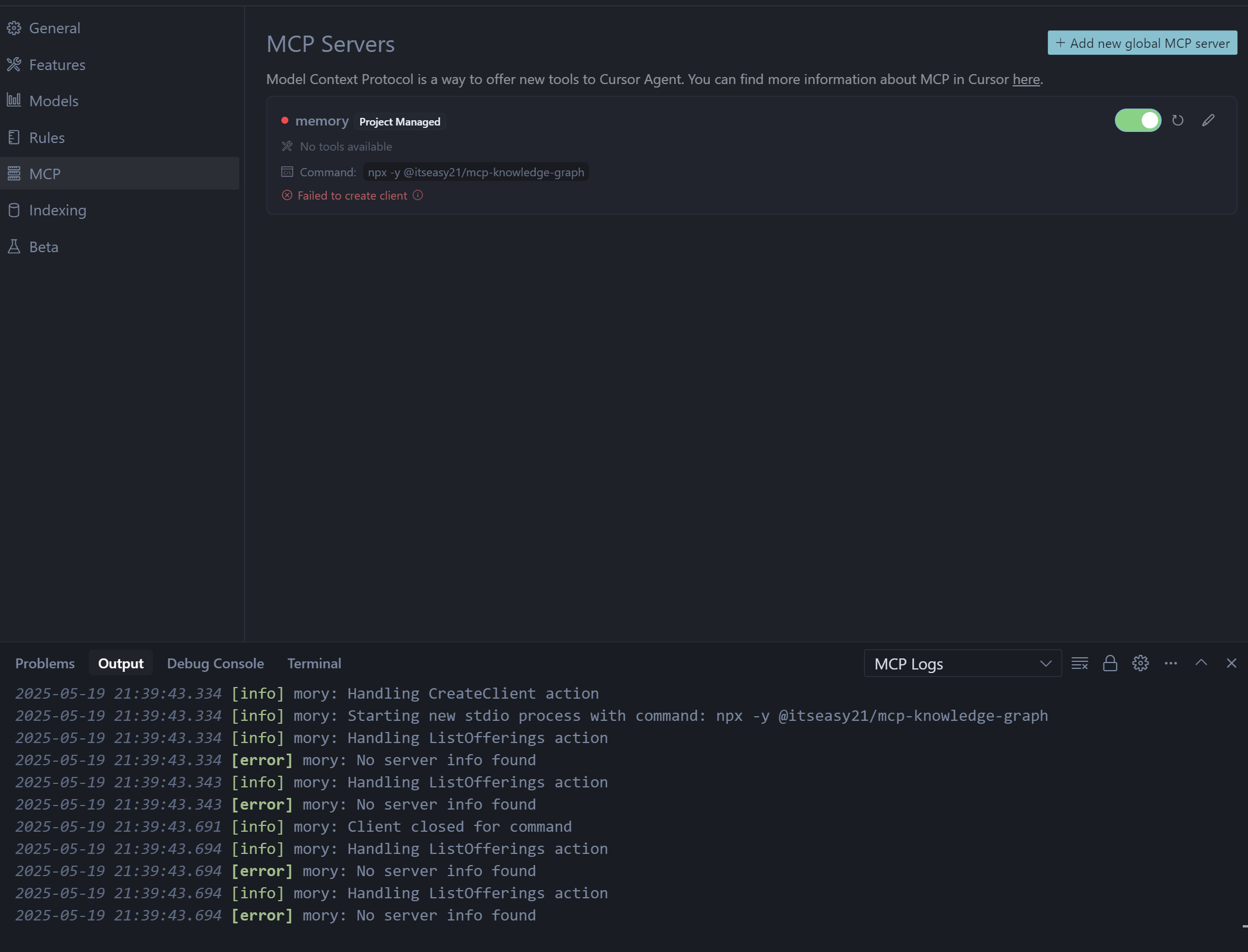
was working previously until i uninstall cursor and now i keep getting this error in wls2, any help debugging this,

Woot, wish I had joined this forum a few years back lol 100% on this. wanted to share this link as well because it has a lot of information over time on this concept. 2022 kruel.ai had persistent agent and code ability. This last year it hit 1% usage of cursor 11.6b tokens. Its currently using a system call KRED which is pretty much what this MCP concept mentioned by OP does but with kruel.ai

There is so much more you can do it does not have to stop with semantic and graph relationships. https://kruel.ai

This is a great contribution :blush: — persistent memory is clearly one of the most painful gaps in daily Cursor usage.

Thank you for sharing this so openly with the community.

I’d like to add another perspective and invite feedback on a complementary approach we’ve been building and using in production for over a year: ODAM for Cursor (Ontology-Driven Agent Memory).

Unlike file-based or static memory graphs, ODAM focuses on semantic, time-aware, and outcome-driven memory, designed specifically to reduce noise and token waste in real-world development.

How ODAM differs architecturally:

  • Dynamic entities, not static facts

    We extract entities (tech stack, folders, errors, solutions, preferences, patterns) continuously from chat + code activity. Entities evolve over time instead of being appended forever.

  • Temporal relevance & success filtering

    Memory is ranked by recency, semantic similarity, and outcome.

    Failed or deprecated solutions are explicitly marked and excluded from positive context injection.

  • Selective context injection (not full recall)

    Only high-confidence, relevant memory is injected into the active Cursor context in real time — not the full history.

    This keeps prompts short and precise.

  • Code-aware memory

    We track code artifacts, fixes, regressions, and architectural decisions — not just text conversations.

  • Measured impact

    For our team, ODAM reduced repetitive prompt corrections and follow-up clarifications enough to save up to ~80% of tokens on longer projects, while significantly improving code consistency.

How it integrates with Cursor:

  • Uses official Cursor hooks (beforeSubmitPrompt, afterAgentResponse, afterAgentThought)

  • Injects memory into .cursor/rules/odam-memory.mdc

  • Cursor reads this file natively — no forked behavior

  • Local hooks → secure local event server → ODAM API

  • Fully isolated per user and per project

Links if anyone is interested in reviewing or comparing approaches:

We’d genuinely appreciate feedback from the Cursor community — especially comparisons between local static memory graphs vs. semantic, time-aware memory in long-lived projects.

Happy to answer any technical questions or discuss trade-offs.

1 Like

This is KRED its a cursor-agent using Kruel.ai Brain. (1/4 of the current. could not render it all)

KRED (Kruel Research Engineering Design)
Its built into one of our Ai’s and manages the Ai and fixes it from with in the system.
Its using V8.2 memory of our system. (Kruel.ai has had Agentic memory since 2022).
its all I build is memory designs.