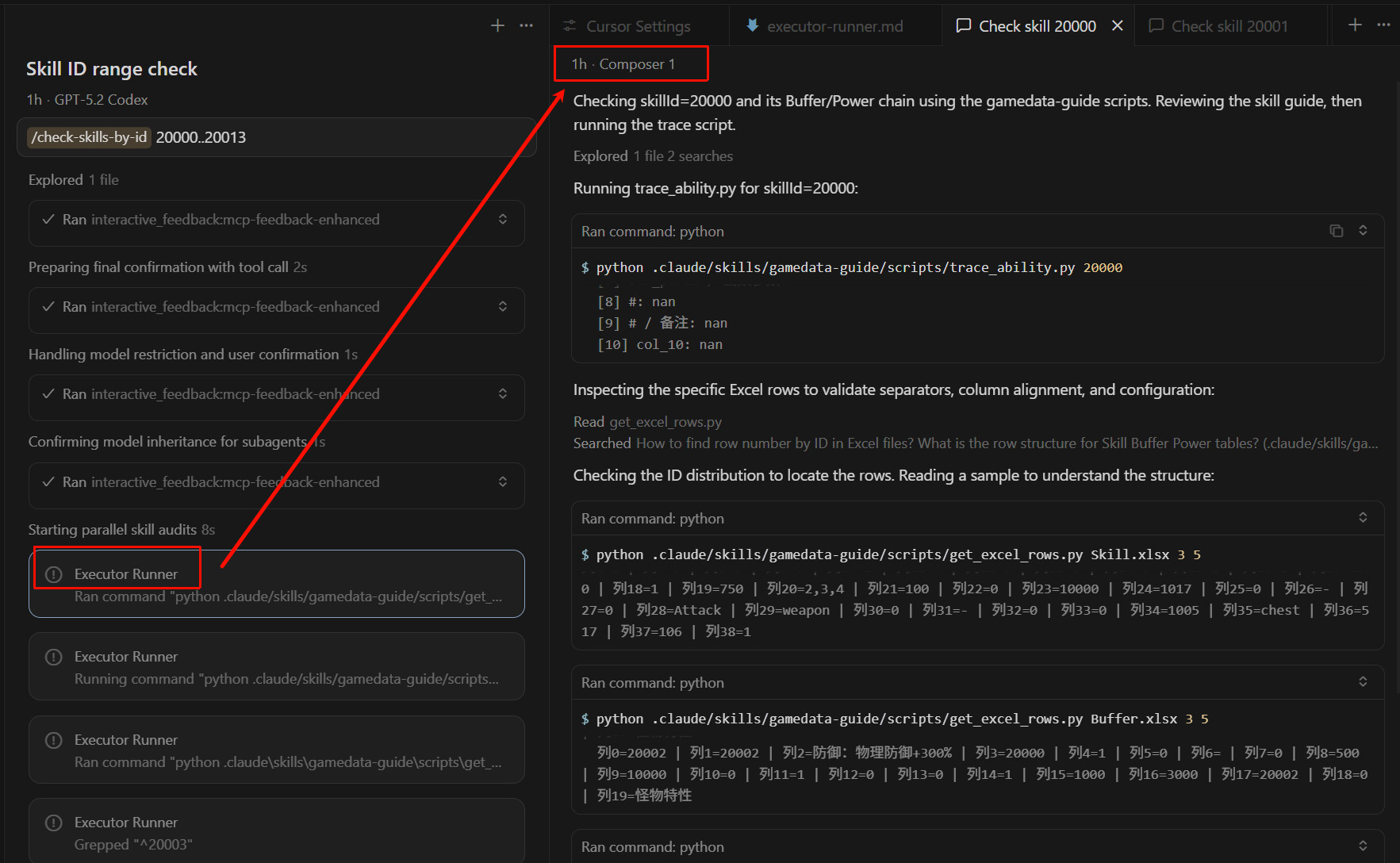
I’m invoked the preconfigured subagent as specified in the prompt ,which designated the GPT-5.2 Codex model for its use;howerver,composer 1 is invariably used in actual operation.
My configuration of subagent is shown below:
name: executor-runner
model: gpt-5.2-codex
description: Execute implementation tasks and tool/script runs. Use when the user asks to implement features, modify code, run CLI tools/tests, or execute scripts.
Steps to Reproduce
Use /subagent to explicit call preconfigured subagent,which is designed use GPT-5.2 Codex model
Hey, thanks for the report. This is a known limitation with subagent models.
Can you check your plan type? Go to https://cursor.com/dashboard?tab=usage - if you see a “requests” counter (not dollar amounts), you’re on a request-based plan.
On request-based plans, subagents only use Composer 1 until you either:
Enable Max Mode (Settings > Features), or
Exhaust your included requests (switching to on-demand usage)
Once Max Mode is on or you’re on on-demand, your model: gpt-5.2-codex config should work.
Ah,i see,yes,i’m on a request-based plan.
I have no problem with this limitation,but it would be better if you could write it clearly in the document or provide tips in the relavant UI.
Our docs definitely reflect a previous state (Max-mode required for all subagents on request-based plans). Now, subagents are available, but limited to composer-1.
With regards to this topic, going forward, it would be good if we could have a subagent picker on the IDE itself, i.e. when I choose the main model, if I am in a need of subagent, I could pick the relevant subagent on my own. Currently I developed a plan using 4.6 Opus Max, and I asked it to execute it. I did expect it to delegate the work to the lower-end models, but not to composer-1 (at least I was expecting to get composer-1.5). I checked it based on the usage section in the dashboard, and that’s where I saw it: